
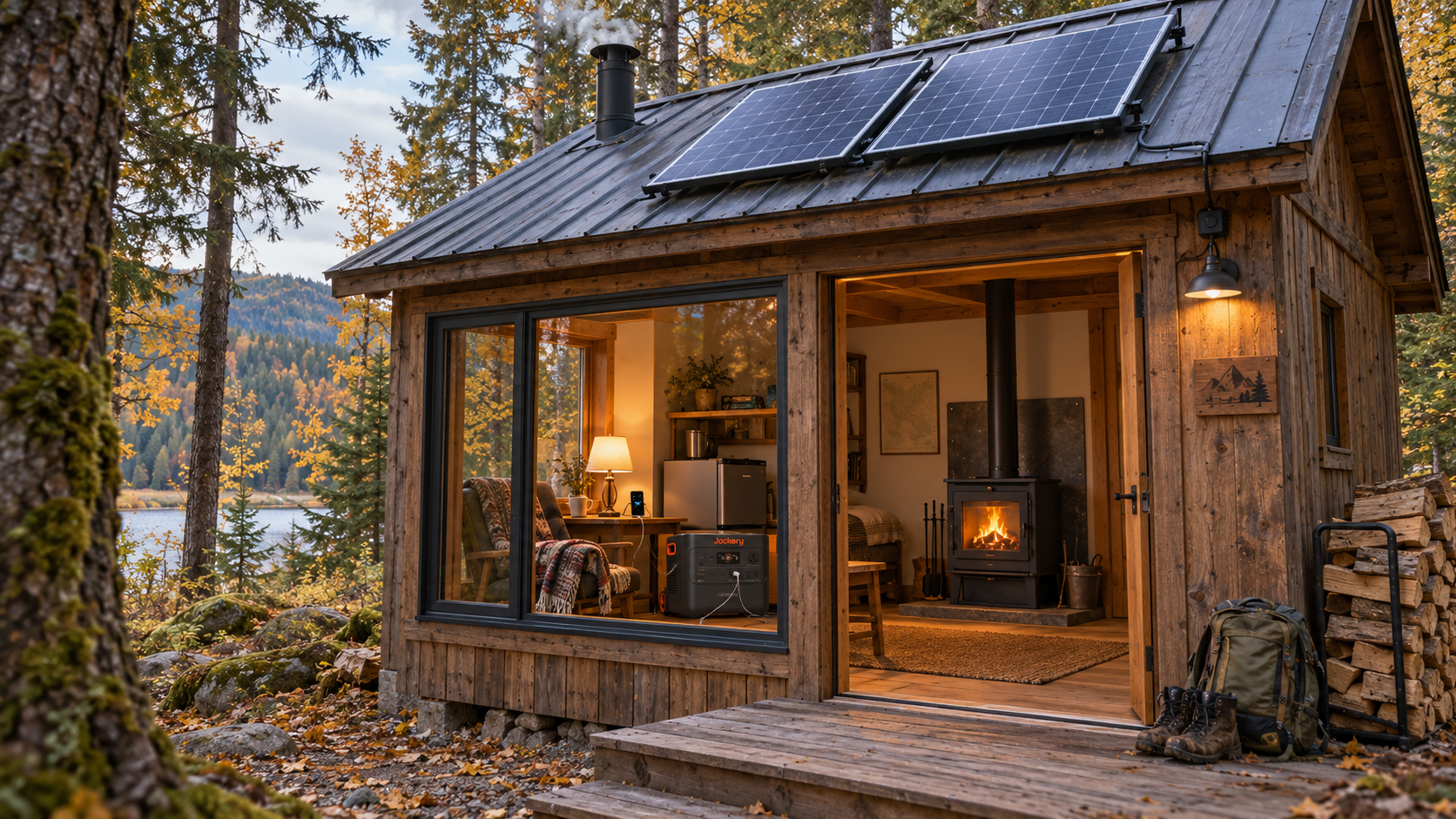
An off-grid cabin needs a workable plan for warmth, light, communication, and food storage. The Fortress Foundry Off Grid Survival Pack concept combines a wood stove, a Jackery Explorer 2000 Plus, and solar panels so each piece has a clear job. Here is how that setup could work during a quiet weekend in the woods—or a power outage that lasts longer than expected.
A realistic evening in an off-grid cabin
The temperature drops as daylight fades. A properly installed wood stove warms the cabin while a charged power station supplies an LED lamp, charges a phone, and keeps a small radio available. Roof-mounted solar panels collected energy earlier in the day. A compact refrigerator can be part of the plan, but its measured daily energy use must fit the battery and solar budget.
This approach saves stored electricity for tasks that need it. Burning seasoned firewood provides space heat; insulation, warm bedding, and sensible power use help the supplies last.
What each component does
Wood stove: Choose a stove specifically approved for indoor use and suitable for the cabin. A portable tent or camping stove is not automatically suitable for a building. Have the hearth, clearances, shielding, and chimney designed and installed to the stove instructions and local requirements. Keep working smoke and carbon-monoxide alarms in the cabin.
Jackery Explorer 2000 Plus: The original JE-2000C model has a rated battery capacity of 2,042.8 watt-hours. Capacity describes stored energy; the inverter output rating describes how much power it can deliver at one time. Neither number means unlimited runtime. Check the exact model manual before selecting appliances.
Solar panels and cables: The earlier pack description specified two 100-watt panels. Treat that as a 200-watt planning example, and confirm the current equipment and compatibility before ordering. Roof mounting also requires suitable rails, weatherproof cable entry, and a mounting design appropriate for the roof and local conditions.
How long will the battery run essentials?
Start with each device’s watts and the hours you will use it: watts × hours = watt-hours. Add the devices together, then allow for conversion losses, the power station’s own consumption, and a reserve.
For example, a 10-watt LED lamp used for five hours needs 50 Wh. Allowing 20 Wh for phone charging and 20 Wh for a small radio gives a simplified 90 Wh daily device budget. These are planning assumptions, not tested runtimes. Refrigerator use, inverter standby consumption, cold weather, and other loads can increase the total substantially.
For a continuous 30-watt load, assuming 80% of the rated battery energy is available to the load gives about 54 hours: 2,042.8 × 0.8 ÷ 30. The 80% allowance is an illustration, not a Jackery guarantee; actual runtime may be shorter. Measure the complete setup before relying on it.
Can two solar panels keep up?
A 200-watt array receiving four equivalent hours of full sun represents 800 Wh before system losses. That is a calculation, not a daily harvest forecast. Shade from trees, clouds, winter sun angles, snow, and cable losses reduce production. A bright-looking woodland roof can still be a poor solar location.
Even at an uninterrupted 200 watts, replacing 2,042.8 Wh would take more than 10 hours before losses. With limited daily sun, a full recharge may span several days, especially while appliances are running. Build the plan around local seasonal production and keep reserve energy for cloudy weather.
Set up the cabin before you need it
Keep the power station dry, ventilated, and well away from stove heat. Follow its charging temperature limits and the panel voltage, current, connector, and wiring requirements in the manufacturer’s manual. Do not connect it to building wiring through a wall outlet; any fixed electrical integration needs suitable equipment and a qualified installer.
Before a trip, fully charge the battery, test the intended devices, record their energy use, and check the weather. Store dry firewood, drinking water, shelf-stable food, a manual can opener, spare lighting, and warm layers. A cabin power setup supports these basics; it does not replace them.
Build around your actual needs
Start with the loads you need every day, then choose storage and charging capacity to match. If refrigeration or additional equipment is essential, measure it first rather than guessing from the appliance size. Confirm current pack contents, availability, mounting hardware, and installation needs through our gear page before making a purchase.
Technical reference: Jackery Explorer 2000 Plus user manual. Calculations above are illustrative planning examples; the cabin scene is a visual concept, not a documented installation.

