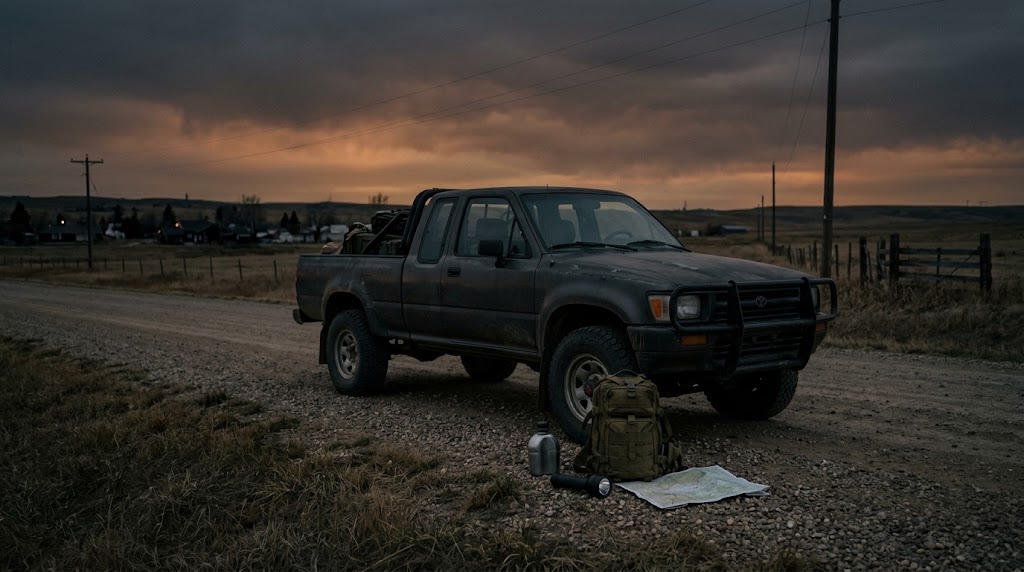
An electromagnetic pulse raises an unsettling question: would your vehicle still run when you need it most? The honest answer is that no reliable percentage is available for a particular make, model, and year. But there is useful test evidence—and practical preparation you can do today.
Check your vehicle
Select your vehicle below for an estimated resilience rating based on its assumed powertrain and recovery dependencies. You can override the assumed engine controls to match your actual vehicle. This is a qualitative planning assessment, not a tested survival probability.
Vehicle EMP resilience estimator
Choose a make and model, then enter the year to receive a qualitative planning rating. Selected models are examples, not a complete catalog. Year is entered manually; this tool does not validate production years.
What vehicle testing found
The 2008 EMP Commission report describes laboratory tests of 37 cars built between 1986 and 2002. Exposure increased until a malfunction occurred or the simulator reached approximately 50 kV/m. Testing stopped at the first abnormal response, so not every car received the maximum exposure.
With engines off, the tested cars showed no subsequent effects. With engines running, three stalled at approximately 30 kV/m or above, one suffered dashboard damage requiring repair, and many showed minor disturbances. These results do not establish a survival rate for a specific vehicle or for today’s fleet. The report does not identify the tested cars by make and model.
Source: EMP Commission, Critical National Infrastructures (2008), printed page 115.
Why this tool does not promise a percentage
A percentage would need a defined outcome: remaining completely unaffected, continuing to drive, restarting after a stall, or operating after repairs. Those are different questions. It would also need representative testing of the selected vehicle under specified exposure conditions. A model name alone does not supply that evidence.
Older does not automatically mean immune, and newer does not automatically mean disabled. Our estimated ratings describe operating and recovery dependencies: most combustion vehicles receive Moderate potential resilience; a confirmed mechanical diesel receives Higher potential resilience; a battery-electric vehicle receives Limited recovery flexibility because propulsion controls and charging are essential. These categories are our low-confidence planning judgments, not measured differences in EMP susceptibility. No percentage or make-specific test result is implied.
An EMP and a solar storm are different planning problems
The vehicle tests above concern simulated EMP exposure. Solar storms can disrupt the power grid, GPS, radio, and satellites; NOAA explains that geomagnetically induced currents can affect long conductors such as power lines. Solar-storm warnings should not be treated as proof that every vehicle’s electronics will fail. See NOAA’s space weather explainer and its infrastructure overview.
Prepare for disrupted transportation
- Keep supplies accessible. Pack water, shelf-stable food, a flashlight, first-aid supplies, weather-appropriate clothing, and essential personal items. Review supplies regularly.
- Keep a fuel reserve in your tank. Pennsylvania’s preparedness guidance recommends keeping gasoline vehicles at least half full. For an electric vehicle, make routine charging part of your plan rather than relying on a last-minute charge.
- Plan without navigation apps. Keep a paper map, written contact numbers, and a family meeting plan. Think through what you would do if fuel, charging, communications, or roads were unavailable.
- Plan for staying put. A working vehicle does not guarantee a usable route. Follow emergency instructions and consider the needs of anyone who cannot travel independently.
See Ready PA’s emergency supply guidance. Charging and paper-map suggestions are Fortress Foundry planning recommendations, not claims of EMP protection.
If a nuclear explosion occurs, shelter comes first
A car is not adequate protection from fallout. If you are driving when a detonation occurs, stop safely and duck down. After the shock wave passes, seek the nearest suitable building; a basement or the center of a large building offers better protection. Get inside, remain sheltered, and follow official instructions. Keep a battery-powered or hand-crank radio and emergency supplies available.
If exposed to fallout, remove contaminated outer clothing and wash exposed skin when possible. Follow the FEMA nuclear explosion safety sheet and CDC radiation emergency guidance.
Build a plan that works even if the car does not
Choose preparedness steps that help during many disruptions: supplies, maintenance, communication plans, and alternatives to driving. Treat any unsupported promise of an “EMP-proof” vehicle with skepticism. Your plan should cover both a vehicle that still runs and one that cannot be used.
Research reviewed October 7, 2026. This article and selector do not certify vehicle hardening or predict individual survival.
Start with essentials you already own using our 72-hour family emergency kit checklist. It helps you calculate stored water needs and identify supplies to gather before buying replacements.