
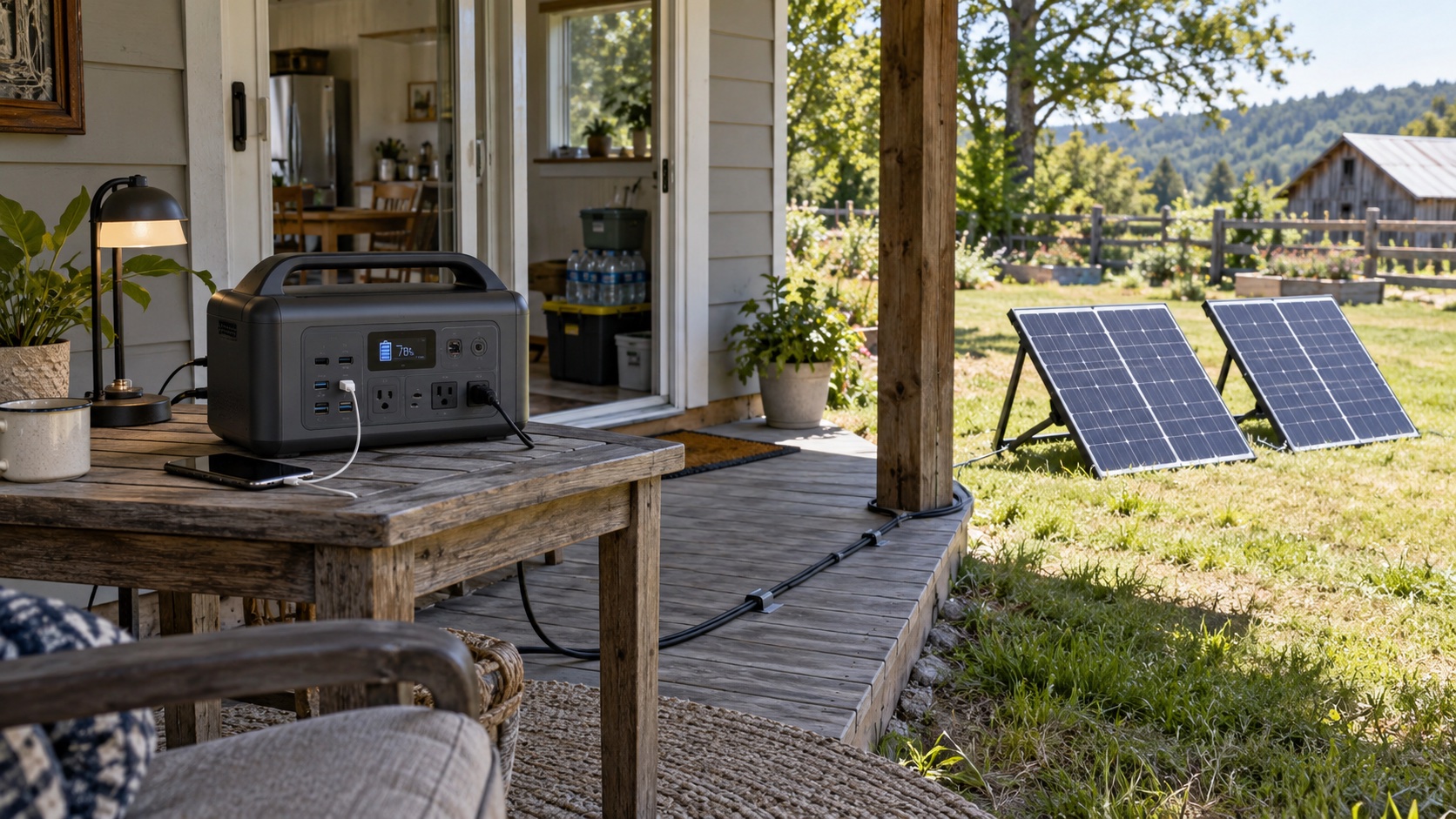
A solar generator can keep a few essential devices running during a power outage, but choosing one starts with your electricity needs—not a model number. This guide explains how portable solar generators work, how to estimate battery runtime, and how to build a charging plan that accounts for cloudy days.
What is a solar generator?
The term usually describes a portable power station paired with compatible solar panels. The panels produce electricity, a charge controller manages charging, the battery stores energy, and an inverter supplies AC power to suitable appliances. USB and DC outlets can power compatible devices directly.
A charged battery can work after sunset. The solar panels need usable daylight to replenish it. Whether the system lasts through a multi-day outage depends on the energy you use, the battery reserve, and the solar energy you can collect.
Start with the essentials you want to power
Write down the devices you need and how long each will run. Lighting, phone charging, and a small radio are a different job from refrigeration, a well pump, or electric heating. Check each device’s label and measure actual consumption where possible.
For a refrigerator or freezer, measure energy over a full day with a suitable plug-in meter; the compressor cycles on and off. Confirm its starting surge separately against the power station’s specifications. Internet equipment may stay powered while the provider’s network is unavailable, so keep another way to receive updates.
Watts and watt-hours: the two numbers that matter
Watts (W) describe power at a moment in time. The inverter’s continuous output must support the appliances running together, and its surge capability must accommodate starting loads. Watt-hours (Wh) describe stored or consumed energy. A model name containing “2000” or “3000” does not establish either specification.
For a steady load, use this rough estimate: runtime in hours ≈ battery Wh × usable-energy allowance ÷ load W. The allowance accounts approximately for losses and reserve; it varies by equipment, settings, temperature, battery condition, and load.
For illustration, a 1,000 Wh battery with an assumed 80% available to a continuous 50 W load gives about 16 hours. At 500 W, the same calculation gives 1.6 hours. These are arithmetic examples, not measured product runtimes. Inverter standby consumption can materially shorten runtime at small loads.
Build a simple daily energy budget
Multiply each device’s watts by its operating hours. For example, a 10 W light used for five hours needs 50 Wh, a 40 W fan used for four hours needs 160 Wh, and an assumed 20 Wh phone recharge brings that example to 230 Wh per day before additional system losses. Replace these assumptions with your own measurements.
Add refrigeration and other essentials to that total, then allow a reserve for poor weather. A system that barely covers one ideal day offers little flexibility when sunlight or battery capacity falls short. Electric space heaters, kettles, and hot plates can consume stored energy quickly; compare their energy needs before including them.
Size solar charging for your location
Panel wattage is a rating under specified test conditions, not a promise of constant output. Sun angle, shade, temperature, cloud cover, and wiring losses change production. Keep portable panels in suitable sun while placing the power station in a dry, protected location within its operating limits.
As a planning example, 200 W of panels multiplied by four equivalent full-sun hours gives 800 Wh before losses. Equivalent full-sun hours describe the day’s solar energy, not simply the time between sunrise and sunset. Actual energy stored will be lower, and winter or storm conditions may reduce it further.
Check the power station’s maximum solar input and the permitted voltage, current, polarity, and connectors. More panel watts do not guarantee faster charging if the input is already limited. Follow the manufacturer’s approved wiring guidance; a matching plug alone does not establish electrical compatibility.
What to compare before buying
Compare usable battery capacity, continuous and surge output, charging speed with the panels you will actually use, weight, warranty, and replacement support. Check whether extra batteries are supported and what they cost. Confirm the exact model and included accessories; product families can contain very different versions.
If uninterrupted power is essential, check transfer-time specifications and compatibility with the device manufacturer. A portable power station is not automatically a suitable medical backup or a zero-interruption UPS. Test the complete arrangement under normal conditions before depending on it.
Use it safely and keep it ready
Use intact, correctly rated cables and follow the equipment instructions for ventilation, moisture protection, storage, and temperature. Never feed a home circuit through a wall outlet. Supplying building circuits requires an approved installation and a qualified electrician. Ordinary grid-connected rooftop solar also does not automatically keep a house powered during an outage.
Charge and test the station before severe weather, label essential cables, and keep a record of measured loads. Inspect the equipment periodically and follow the manufacturer’s storage-charge guidance. Power is one part of preparedness: water, food, lighting, communication, and warm bedding still need their own plan.
Choose a system around your plan
For a woodland example, see our off-grid cabin power and wood-heat guide. When comparing options through our gear page, confirm current availability and specifications before ordering. Begin with measured essentials, then match the battery and solar charging to the job.
Further reading: U.S. Department of Energy: Solar and Resilience Basics; Jackery: choosing a portable power station. All numerical examples above are illustrative, not product test results.

