This follow-up to our household outage preparation plan focuses on two different jobs: receiving reliable information and contacting other people. A charged phone helps only while a usable network is available. A radio may provide updates without giving you a way to reply. Plan both jobs for your household before buying more equipment.
Start with a family-of-four communication kit
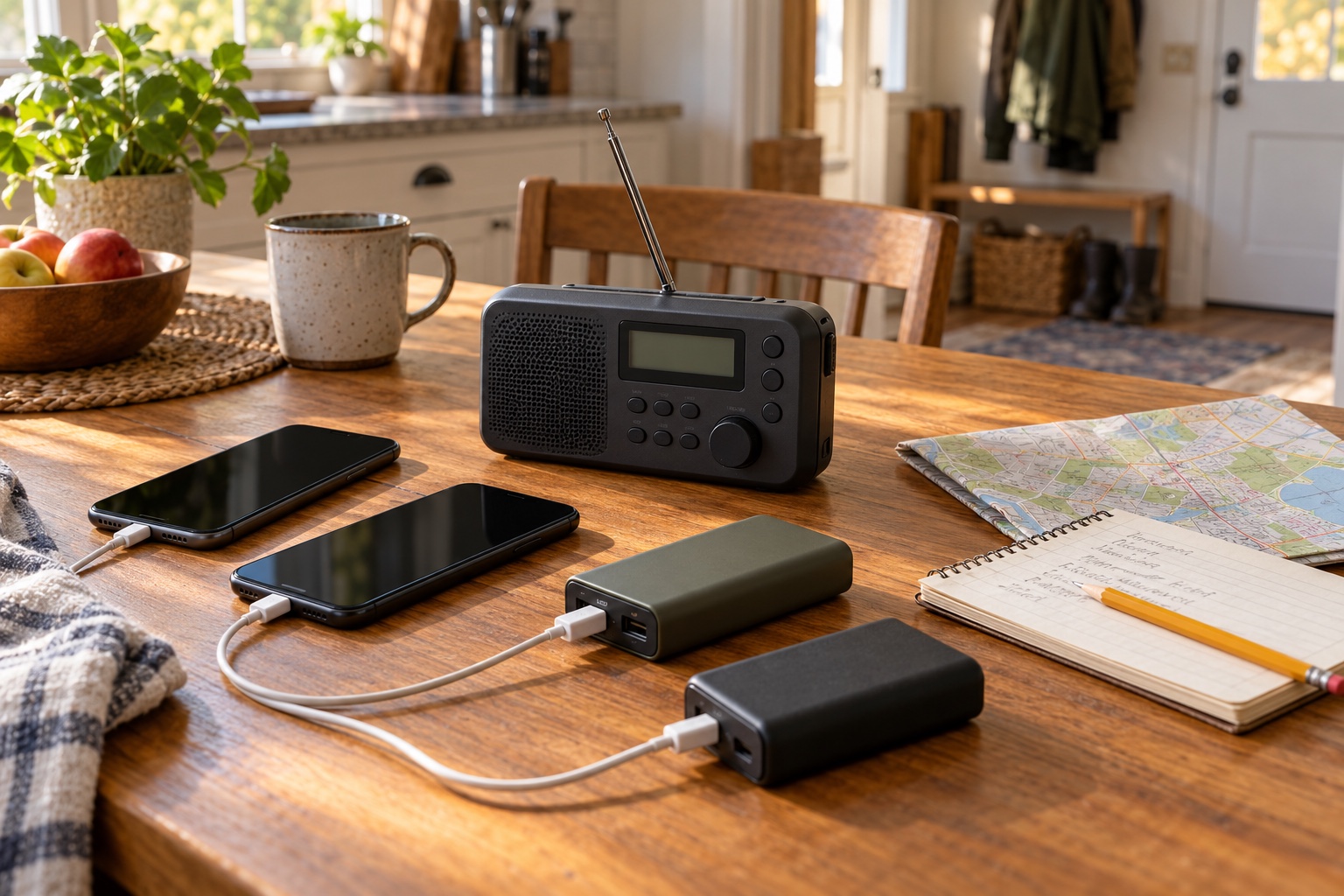
Keep a printed contact sheet, two agreed meeting places, a battery-powered radio, compatible spare batteries, charging cables for the phones you actually use, and suitable charged power banks. Include an out-of-area contact, school or caregiver arrangements, utility reporting details and local emergency information sources. Store sensitive details privately. Give each household member an accessible copy appropriate to their age and needs.
Four people do not necessarily need four phones or four radios. Count actual devices, independent travel and accessibility needs. For an additional person, add their contacts, care arrangements and any device charging load. For a smaller household, remove those individual requirements while retaining shared alert reception and a meeting plan.
Check what your radio can receive
An AM/FM label alone does not establish NOAA Weather Radio reception. The National Weather Service explains that NOAA Weather Radio needs a compatible receiver. Check local coverage, reception inside your home and the manual’s alert settings before relying on it. Choose accessibility features that fit the people using the equipment. Transmitters and receivers can fail, so retain another source of information when available.
Budget charging from actual devices
List each device, its usable battery or charging requirement, planned daily use and charging method. Record how much energy a normal day consumes using measurements where practical. Multiply daily watt-hours by the number of days to estimate device-side energy demand. Charging losses and a power bank’s output limitations mean its label capacity is not all available to your phone. Compare watt-hours and compatible outputs; milliamp-hour figures at different voltages are not directly interchangeable.
For example, an assumed combined device demand of 20 watt-hours a day would total 600 watt-hours over 30 days before charging losses. This is arithmetic, not a measured family requirement or a product-runtime claim. Replace that assumption with your own use. Our backup-power planning guide helps connect essential loads with charging options.
Plan for longer interruptions
| Planning horizon | Days | Device-side energy calculation |
|---|---|---|
| One month | 30 | 30 × your daily device energy |
| Three months | 90 | 90 × your daily device energy |
| Six months | 180 | 180 × your daily device energy |
| One year | 365 | 365 × your daily device energy |
| Two years | 730 | 730 × your daily device energy |
Longer planning horizons call for replenishment, upkeep and alternative arrangements. They do not justify multiplying phones and radios by the number of months. Keep charging equipment compatible and follow its manufacturer’s storage and inspection instructions. Test reception and controls, update contacts after changes, and practice a check-in without disrupting essential care or calling emergency numbers as a test.
Agree on what happens when contact fails
Write down when to check in, who contacts whom and where to meet if messages do not arrive. Agree on a safe fallback if the first meeting place is inaccessible. Match the plan to work, school, mobility and transport arrangements. Follow actual local emergency instructions when conditions change; a planned meeting does not override an evacuation instruction.
Keep unexpected payment or account-access requests separate from emergency coordination. Verify them through contact details you already trust. A familiar-looking account or voice alone is not confirmation. Connect this plan with the Be Prepared supply tree and your household water, food and lighting arrangements. For downloaded manuals and reference material, see our Project NOMAD overview; an offline library does not provide outside communication.