Lighting is the next step in our household outage preparation plan. For a family of four, start by deciding who needs to move around independently and which shared spaces need light. The quantities below are a planning example, not an official minimum or a promise that particular batteries will last a month.
Build a useful lighting kit
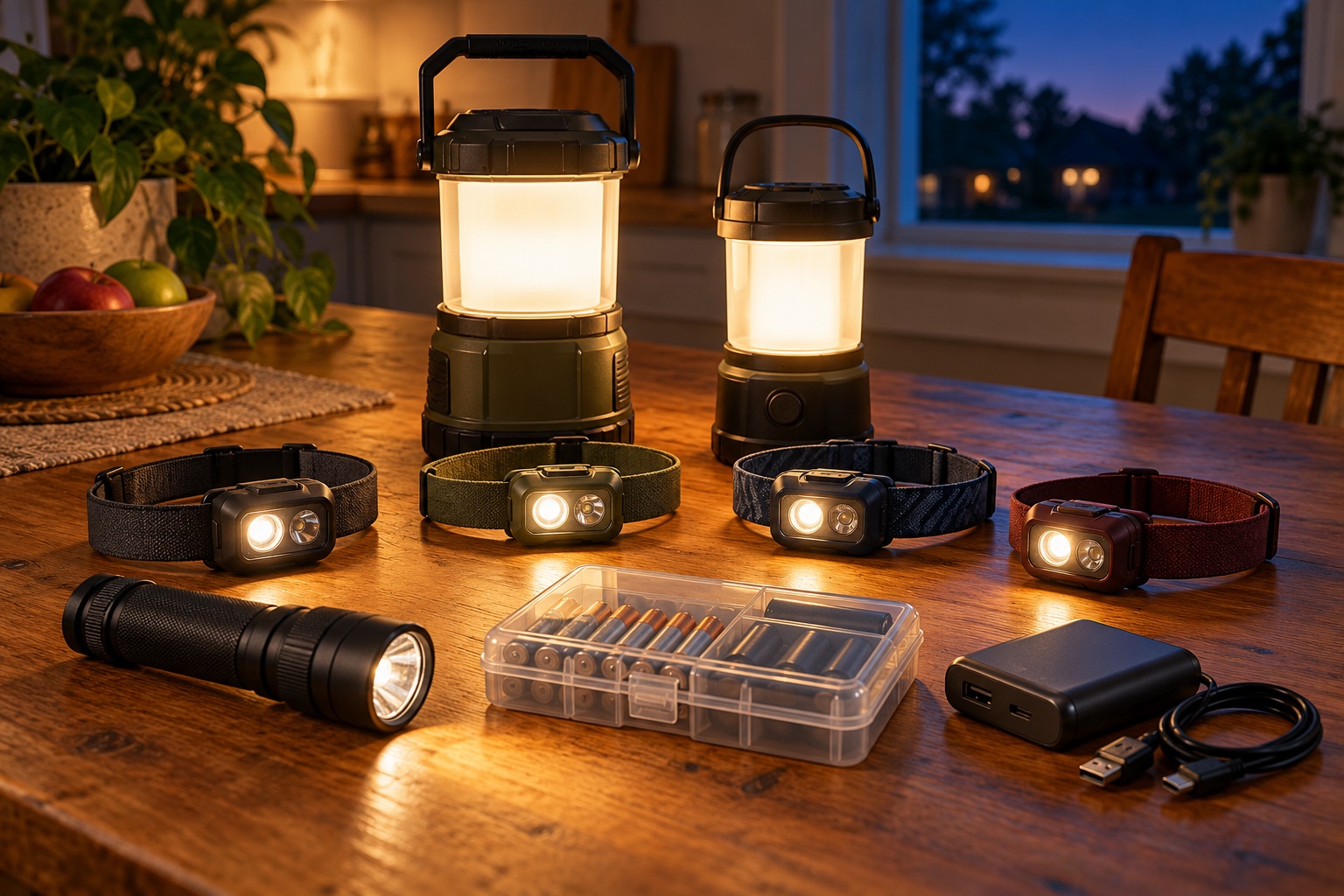
A practical starting list is four personal LED lights or headlamps, two shared LED lanterns, compatible batteries or charging cables, and a written inventory of battery types. Choose controls each person can use. Young children may need supervised access and help handling batteries. Add one suitable personal light for each additional person; subtract one when planning for a smaller household. Shared lantern needs depend on rooms and activities, not just headcount.
Keep a light within reach near sleeping areas and another where household members gather. Check the route to the bathroom and exits. A headlamp can leave hands free for ordinary tasks; a lantern spreads light across a shared area. Test placement and glare before relying on either. Avoid running every light at maximum brightness when a lower setting meets the task.
Calculate operating hours first
For each light, multiply hours used each day by the number of days. Then divide by a conservative usable runtime for the exact light, battery and brightness setting, rounding up to complete battery sets. Multiply sets by cells per set. Include the batteries already installed when calculating total cells; subtract usable installed cells to find spare cells needed.
For example only: suppose four lights each run two hours daily and each uses three cells per 20 usable hours. These are invented arithmetic inputs, not product specifications or test results. Each light needs 60 hours for a 30-day month: three complete sets, or nine cells. Four lights need 36 cells total, including 12 installed cells; that leaves 24 spare cells. Shared lanterns require their own calculation.
One month through two years
| Planning period | Days | Example cells: four people | Example cells: per person |
|---|---|---|---|
| One month | 30 | 36 | 9 |
| Three months | 90 | 108 | 27 |
| Six months | 180 | 216 | 54 |
| One year | 365 | 444 | 111 |
| Two years | 730 | 876 | 219 |
For a different household size, multiply the per-person cells by the number of people. Replace the example’s runtime and usage with your actual equipment data. Published maximum runtime can describe a different brightness mode or a gradually dimming light; check the manual and test whether the light remains useful for your task. Allow an additional reserve appropriate to uncertainty, temperature and battery condition.
Longer plans need a replenishment method
The table shows why buying disposable batteries for years of continuous use can become impractical. For three months and beyond, compare a rotating battery reserve with rechargeable lights or cells and a dependable charging plan. Record charging requirements, compatible chargers and how you would manage several cloudy days or failed equipment. Our backup-power planning guide explains how to budget electrical loads. A solar panel alone does not establish that a light or charger is compatible.
Store, inspect and practice
Energizer’s battery-care guidance recommends following device instructions, using the specified battery type, storing batteries in a cool, dry place, and avoiding mixed old/new cells or different types. Keep loose batteries away from metal objects and batteries out of children’s reach. Recharge only cells marked rechargeable with a compatible charger. Follow the manufacturer’s maintenance schedule and keep a separate light available while another charges.
USFA recommends flashlights instead of candles during outages. Practice finding lights without turning off essential equipment. Review the Be Prepared supply tree, then check your water and food plans alongside lighting.